

Why Businesses Upgrade from Legacy Telecom SystemsYour legacy telecom system isn't failing. That's the problem. The reason why businesses upgrade from legacy telecom isn't because their old systems stop working. It's because those systems keep working just well enough to delay a decision that gets more expensive by the month. For multi-location companies, this trap is especially dangerous. Each location running on separate legacy infrastructure multiplies the hidden cost, the security exposure, and the operational drag. This article breaks down what's actually at stake, what you gain by modernizing, and how to approach the transition without disrupting the business you've spent years building.
Table of Contents
- Key takeaways
- Why businesses upgrade from legacy telecom: the hidden cost problem
- What you actually gain by modernizing
- The real challenges of migrating away from legacy systems
- Strategies for upgrading telecom infrastructure across multiple locations
- My perspective on the real cost of waiting
- How Californiatelecom helps multi-location companies upgrade
- FAQ
Key takeaways
| Point | Details |
|---|---|
| Legacy costs are hidden | Maintenance consumes the majority of IT budgets, leaving almost nothing for growth or new capabilities. |
| Downtime risk is severe | Unplanned outages from aging infrastructure can cost $260,000 per hour in certain industries. |
| Modernization pays back fast | Companies that upgrade typically recover their investment within two to three years through cost savings and productivity gains. |
| Migration requires a phased plan | Gradual approaches reduce risk while keeping your business operational throughout the transition. |
| One provider changes everything | Consolidating to a managed telecom partner eliminates vendor chaos and gives multi-location companies a single point of accountability. |
Why businesses upgrade from legacy telecom: the hidden cost problem
The most dangerous thing about a legacy telecom system is that it works. You can make calls. You can send data. Locations stay connected. Because nothing has visibly broken, the case for change never feels urgent enough to make it through budget approval. But the cost is real. It's just hiding in places most organizations don't look.
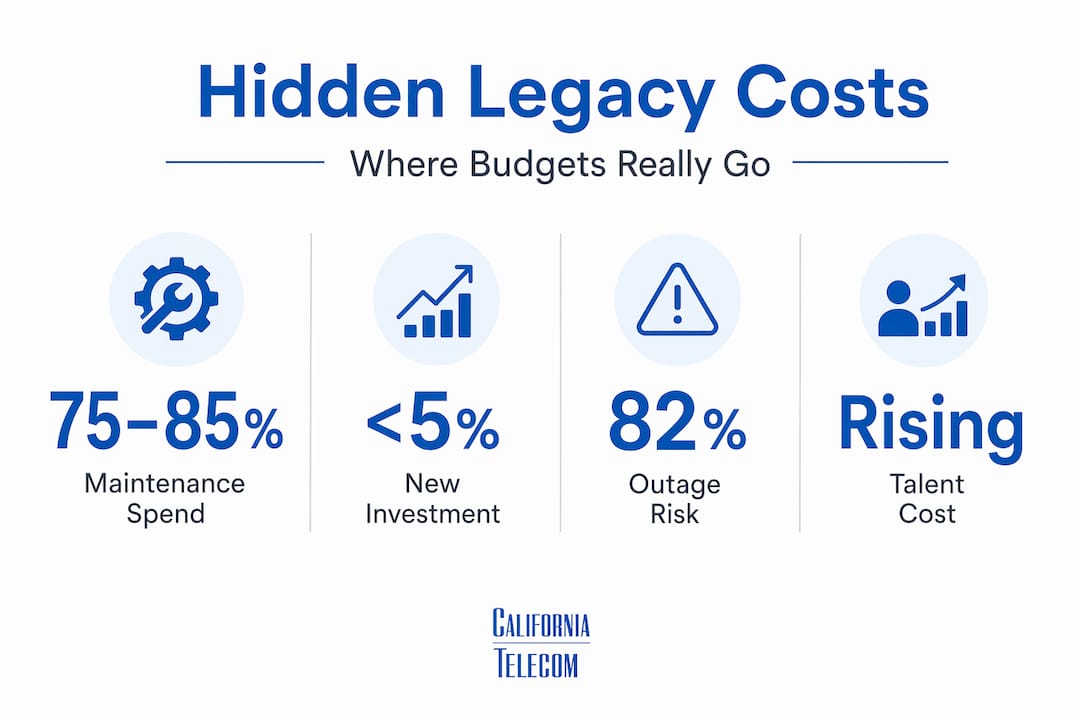
Legacy-heavy organizations spend 75–85% of their IT budgets on maintaining existing systems, leaving as little as 5% available for anything new. Modernized companies flip this ratio entirely, directing up to 50% of IT spending toward innovation. When your infrastructure absorbs most of your budget just to keep the lights on, you're not running a network. You're running a debt.

The operational risks compound that financial drain. 82% of companies suffered major unplanned outages in the last three years, and downtime in some industries costs $260,000 per hour. Legacy systems are a leading cause of those outages because they depend on aging hardware, discontinued software, and carriers who are actively sunsetting the copper infrastructure that POTS lines run on.

Security is another pressure point that doesn't show up on a balance sheet until something goes wrong. Unsupported legacy systems stop receiving patches. Regulatory requirements continue to evolve. The gap between what your legacy infrastructure can do and what compliance frameworks require widens every year, and that gap represents real liability.
There's also a talent problem most leaders underestimate. Maintaining legacy telecom infrastructures is increasingly expensive because the pool of people who know how to maintain these systems keeps shrinking. The ones who do know them cost more each year. And developers spend up to 17 hours per week addressing technical debt on legacy code, which translates to millions in lost productivity annually for large organizations.
Pro Tip: Before building a business case for a telecom upgrade, pull together three numbers: your current annual maintenance spend, the last time a telecom issue caused operational disruption at any location, and how many tickets your IT team opened last year tied to legacy system issues. Those three data points are often enough to make the conversation very short.
What you actually gain by modernizing
Once you understand the full cost of staying put, the benefits of telecom upgrades stop looking like nice-to-haves and start looking like the business case they actually are.
-
Lower ongoing costs. Maintaining legacy POTS lines costs thousands of dollars per month per line for distributed enterprises. Modern cloud-based and VoIP solutions dramatically reduce that spend. Companies that complete modernization programs typically break even within two to three years, after which ongoing savings accumulate.
-
Faster feature delivery. Legacy modernization enables feature release cycles that are up to 60% faster than what legacy infrastructure allows. When you're running on modern architecture, deploying new capabilities across all your locations doesn't require a hardware truck roll or a multi-month vendor engagement.
-
Security you can actually verify. Modern platforms receive active security patches, support current encryption standards, and generate audit-ready logs. For industries operating under compliance frameworks like HIPAA, PCI-DSS, or SOC 2, this isn't optional. It's the baseline, and legacy systems simply can't meet it.
-
AI and unified communications support. AI-native telecom operations reduce costs, improve service quality, and compress operational cycles in ways that are impossible to replicate on legacy infrastructure. If you want AI-assisted support routing, real-time analytics, or unified communications across locations, you need a modern foundation.
-
Productivity recovery. When your people stop working around system limitations and start working with tools that actually support them, the productivity gains show up fast. That's true for your IT team, your customer-facing staff, and the business leaders who've been absorbing operational friction as a normal cost of doing business.
Pro Tip: When evaluating modern telecom solutions, prioritize vendors who can show you uptime SLA documentation and explain their NOC capabilities specifically. A 99.99% uptime SLA on data and 99.999% on voice tells you something real. A vendor who can't show you those numbers is telling you something too.
The real challenges of migrating away from legacy systems
Knowing why the upgrade matters and knowing how to execute it are two different conversations. The challenges of legacy telecom migration are real, and pretending otherwise will create planning failures that cost more than the original delay.
The deepest challenge is embedded business logic. Replacing legacy telecom entails re-encoding decades of rules and configurations that were built into systems over time by people who may no longer work at your company. Nobody has a complete map of what the system actually does. That's not an exaggeration. It's one of the most consistent findings in modernization programs across industries.
There are two broad approaches to handling that complexity, and both have real trade-offs:
| Approach | What it does | Risk level | Long-term outcome |
|---|---|---|---|
| Wrapping | Adds a modern interface on top of legacy systems | Lower short-term risk | Legacy issues remain beneath the surface |
| Full migration | Replaces legacy systems with modern infrastructure | Higher short-term complexity | Permanent resolution, no legacy debt |
Wrapping legacy systems with modern interfaces reduces immediate risk but adds complexity without solving the underlying problem. It's a viable interim step, not a destination. Full migration requires a phased approach to manage risk, but it's the only path that actually eliminates the liability.
Beyond technical complexity, you need cross-functional alignment. IT, operations, finance, and location leadership all have to be on the same page about scope, timeline, and acceptable disruption windows. Organizations that try to run telecom upgrades as purely IT projects consistently underestimate what it takes to keep the business running throughout the transition.
85% of enterprises relying heavily on legacy systems struggle with digital strategy execution due to the technical debt those systems accumulate. That's not a technology failure. That's a planning and prioritization failure that the right approach can prevent.
Strategies for upgrading telecom infrastructure across multiple locations
For multi-location companies specifically, upgrading telecom infrastructure requires sequencing, not just selection. Here's how the most successful organizations approach it.
-
Audit before you act. Start with a full inventory of every location's current telecom setup: what's running, who the carriers are, what the contracts look like, and where the biggest reliability or compliance gaps exist. You can't prioritize what you haven't mapped.
-
Target high-impact sites first. Not every location carries the same operational risk. Start with the sites where a telecom failure would be most costly, either in revenue, compliance exposure, or customer impact.
-
Use a phased migration model. Successful telecom upgrades use phased migration approaches like the Strangler Fig pattern, where modern systems gradually replace legacy components while both run in parallel. This maintains continuity while reducing the risk of a hard cutover going wrong.
-
Evaluate managed service partnerships carefully. For most multi-location businesses, the choice isn't just which technology to buy. It's whether to own the operational complexity of running a distributed network or to partner with a managed service provider who already has the infrastructure, carrier relationships, and NOC in place. Providers like Californiatelecom source from 50-plus carriers and handle design, deployment, and 24/7 monitoring through their own engineers, which removes a significant operational burden from internal teams. Understanding why businesses choose a single telecom provider comes down to accountability and simplicity at scale.
-
Build in AI and automation from the start. Automated tools and AI are increasingly vital in legacy code analysis and migration planning. Using AI-assisted tools during the transition speeds up the process and reduces errors, but they require expert validation at every stage.
Pro Tip: If your current telecom setup involves more than three vendors across your locations, the administrative overhead of managing those relationships is itself a strong case for consolidation. One provider, one bill, and one engineer's number is not just operationally simpler. It changes how fast you can respond when something goes wrong.
My perspective on the real cost of waiting
I've worked with enough multi-location businesses to recognize a pattern. The organizations that delay telecom upgrades the longest are almost never the ones with the most complex infrastructure. They're the ones where the legacy system's reliability has become a proxy for stability. Leadership equates "still running" with "good enough," and nobody wants to be the person who introduced disruption by changing something that hadn't technically failed.
What I've learned is that modernization is less about technology projects and more about business risk management. The conversation shouldn't be "can we afford to upgrade?" It should be "what is the upgrade delay costing us every quarter?" Those are very different questions, and the second one usually produces a very different answer.
The biggest modernization risk is delaying upgrades until legacy limitations create a competitive gap that's expensive and slow to close. I've seen companies reach that point. Getting back to parity with where the market had moved took twice as long and cost significantly more than an earlier transition would have.
The clients I've seen succeed at this approached telecom modernization as a business transformation initiative, not an IT project. They had executive sponsorship, realistic timelines, and a clear picture of what success looked like before they started. That framing made every decision simpler.
— Jim
How Californiatelecom helps multi-location companies upgrade
If the case for upgrading is clear but the path forward feels complex, that's exactly where Californiatelecom operates.Californiatelecom provides nationwide managed network services to multi-location businesses, handling everything from carrier selection across a 50-plus carrier network to site design, deployment, and 24/7 U.S.-based NOC monitoring. Their 99.99% uptime SLA on data and 99.999% on voice aren't marketing numbers. They're contractual commitments backed by a real operations team. For businesses replacing aging POTS infrastructure, managed POTS replacement solutions provide a direct path from copper to modern voice without the vendor chaos. Californiatelecom also offers UCaaS and hosted PBX solutions for organizations ready to unify communications across all locations. One provider. One bill. One number to call when something needs attention. That's what replacing legacy telecom actually looks like in practice.
FAQ
Why do businesses upgrade from legacy telecom systems?
Businesses upgrade primarily because legacy systems consume the majority of IT budgets on maintenance while creating security vulnerabilities, compliance gaps, and growing operational risk. The impact of legacy systems on productivity and agility makes modernization a financial and strategic necessity, not just a technology choice.
How much can a telecom upgrade actually save?
Cost savings from telecom upgrades come from lower maintenance fees, reduced per-line costs compared to legacy POTS infrastructure, and productivity recovered from eliminating technical debt. Most companies break even on their investment within two to three years.
What is the biggest risk when migrating from legacy telecom?
The biggest risk is embedded business logic that nobody fully understands, built into legacy systems over decades. Using a phased migration approach and partnering with experienced providers reduces this risk significantly while maintaining continuity.
How long does upgrading telecom infrastructure take for a multi-location company?
Timelines depend on the number of locations, current infrastructure complexity, and migration approach. Phased migrations that use the Strangler Fig method typically move faster and with less disruption than hard cutovers, but a realistic enterprise-wide program spans months, not weeks.
Should we use a managed service provider or handle the upgrade internally?
For most multi-location companies, a managed service provider delivers faster deployment, better carrier access, and lower ongoing operational overhead than building the capability internally. The key is finding a provider with a real NOC, documented SLAs, and engineers who design and deploy each site directly.