
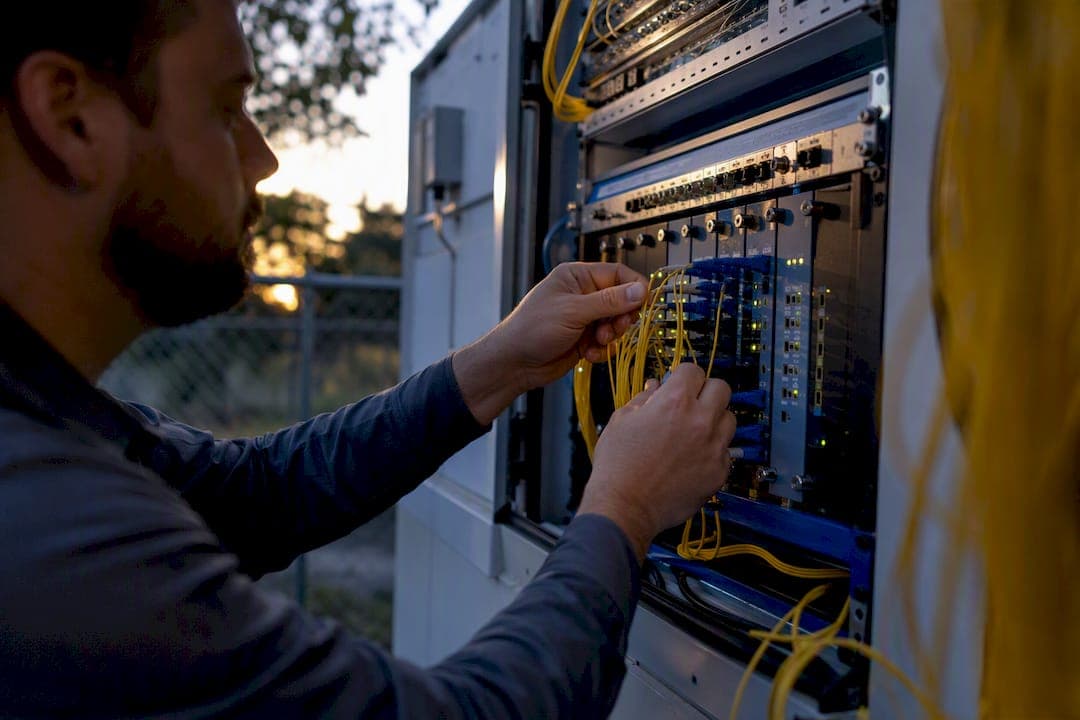
HIPAA-Ready VoIP for U.S. Providers: What to RequireYes, VoIP can support HIPAA-compliant communication, but only if the covered entity treats compliance as a shared job, not a checkbox on a vendor's sales page. A phone system doesn't come compliant out of the box. It becomes compliant when you pair the right platform with a signed BAA, a telephony-specific risk analysis, and verified encryption on every call, voicemail, and transcript that touches patient information.
Before you sign anything or migrate a single extension, get three things done:
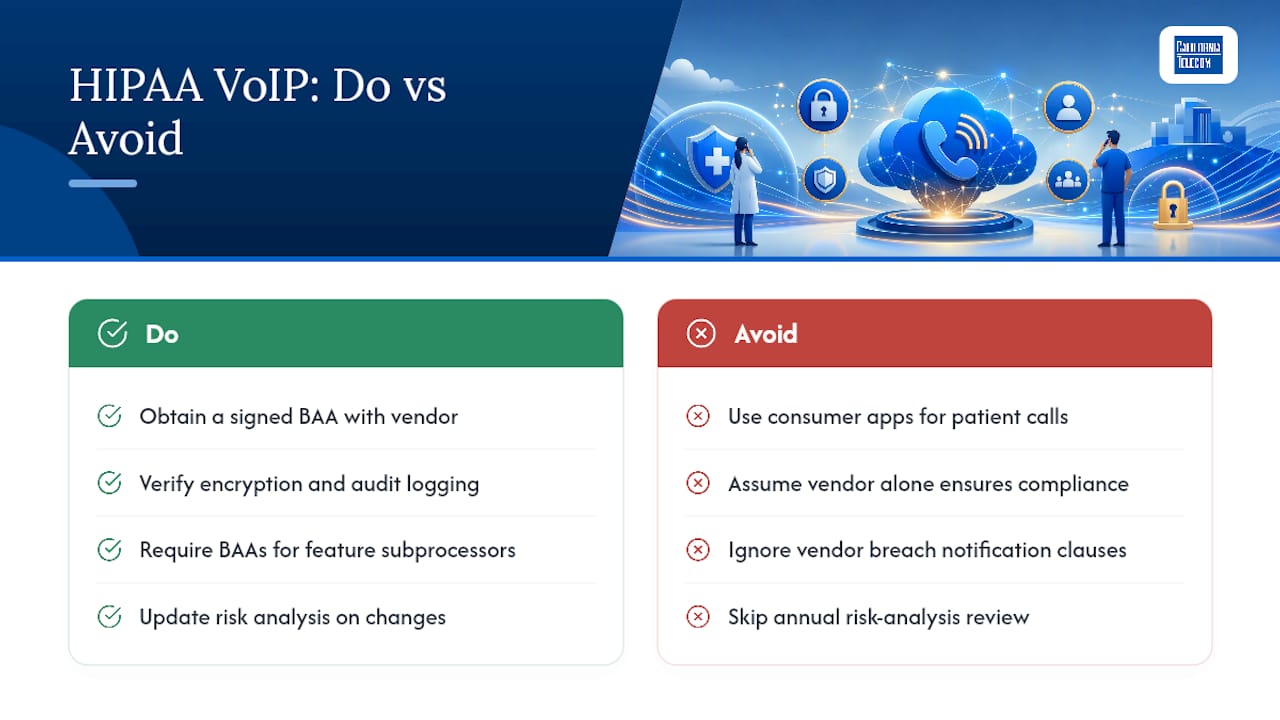
- Get a signed BAA from the VoIP vendor and every subprocessor that touches call data, voicemail, or transcripts.
- Run a telephony risk analysis covering your full stack: desk phones, softphones, voicemail-to-email, recordings, and any AI transcription layer.
- Confirm encryption in transit and at rest (TLS for signaling, SRTP for media, AES for stored recordings) along with audit logging that captures who accessed what and when.
Pro Tip: Ask your vendor for their subprocessors list in writing before you ask about pricing. If they can't produce one immediately, that tells you more than any sales deck will.
Key Takeaways
HIPAA-compliant VoIP works when a signed BAA, a telephony-specific risk analysis, and verified encryption and logging operate together, not when any single piece stands alone.
| Point | Details |
|---|---|
| BAA is the legal foundation | Get a signed BAA covering the VoIP vendor and every subprocessor touching call data, voicemail, or transcripts. |
| Encryption must be verified, not assumed | Confirm TLS for signaling, SRTP for media, and AES for stored recordings before go-live. |
| Voicemail-to-email is a hidden expansion point | Route voicemail through secure portal links or in-platform playback instead of email attachments. |
| Risk analysis needs a telephony-specific scope | Map desk phones, softphones, voicemail, recordings, and AI transcription separately from general IT risk assessments. |
| Managed providers can operationalize controls | Californiatelecom's healthcare network services coordinate network monitoring, carrier redundancy, and vendor BAAs while the client retains ownership of training and retention enforcement. |
Table of Contents
- How HIPAA Compliant VoIP Rules Actually Apply to Phone Systems
- What Technical Safeguards Should You Require From a VoIP Vendor?
- What Must a HIPAA Compliant Voice Services BAA Include?
- How Do You Run a Telephony Risk Analysis for VoIP Compliance?
- Where Do Voicemail and AI Transcription Create Hidden Risk?
- How a Managed Network Provider Builds a HIPAA-Ready Voice Stack
- How Should VoIP Systems Handle Backup and Disaster Recovery?
- What Network Security Controls Protect HIPAA VoIP Traffic?
- What Physical Security Do VoIP Servers and Hardware Need?
- Do You Need HITRUST or Other Certifications Beyond HIPAA?
- HIPAA-Ready VoIP: What to Require and Who's Responsible
- Get a HIPAA-Ready Voice Deployment Built Around Your Network
- Frequently Asked Questions About HIPAA Compliant VoIP
- Sources
How HIPAA Compliant VoIP Rules Actually Apply to Phone Systems
Not every phone call falls under HIPAA. HHS OCR guidance on audio-only telehealth draws a clear line: traditional analog landlines are exempt from the Security Rule because they aren't electronic transmissions in the way HIPAA defines them. VoIP is different. Once a call, voicemail, or text carries electronic protected health information (ePHI) over an IP network, it's covered, and so is any mobile app or softphone doing the same job.
That distinction determines whether your VoIP vendor is a business associate or falls under the conduit exception. A pure conduit, like a common carrier moving data without accessing its content, doesn't need a BAA. But almost no modern VoIP platform qualifies. If the vendor stores voicemails, indexes call logs, runs transcription, or could plausibly access message content, it's a business associate under HHS's own factsheet on the topic, and HITECH makes that vendor directly liable for its share of HIPAA obligations.
Subprocessors complicate this further. Your VoIP provider likely relies on a transcription engine, a cloud storage layer, and maybe a separate SMS gateway. Each one that touches ePHI needs its own BAA commitment, flowed down from your primary contract.
Enforcement has also tightened. The flexible enforcement discretion HHS extended during the public health emergency for telehealth technologies ended years ago. Regulators now expect a documented, telephony-specific risk analysis on file, not a general IT risk assessment that mentions phones in passing. If you can't produce that document during an audit, the absence itself becomes the finding.
What Technical Safeguards Should You Require From a VoIP Vendor?
The gap between a "HIPAA-compliant" marketing claim and an actually compliant deployment usually comes down to configuration, not the platform itself. Industry analysis on VoIP security points to a specific, testable set of controls that OCR investigators look for after a breach. Ask vendors to demonstrate each one, don't just take their word for it.
Transport security comes first. SIP signaling should run over TLS 1.2 or higher, and the actual voice media needs SRTP, not plain RTP. Weak or outdated cipher suites defeat the purpose even when TLS is technically enabled, so ask specifically whether the vendor supports perfect forward secrecy and disables legacy protocol versions like SSLv3 or TLS 1.0.
Encryption at rest matters just as much as encryption in transit. Recorded calls and stored voicemails need AES-128 or AES-256 encryption, and the vendor should be able to explain how encryption keys are managed and rotated. LegalClarity's review of VoIP compliance cases found that OCR has repeatedly treated a total absence of encryption as evidence of negligence in breach settlements, not a minor technical oversight.
Endpoint controls close the loop between the network and the device in someone's hand. That means:
- Managed softphone apps with enforced PIN locks and automatic session timeout
- Remote wipe capability for lost or stolen devices carrying the softphone
- Current OS and firmware patching enforced through mobile device management
- Disabled local storage of voicemail or call recordings on personal devices
Audit logging is the piece most organizations underbuild. You need logs covering access events (who opened a voicemail or recording), playback events (who listened to what, and when), and administrative changes (who altered permissions or retention settings). Retention of those logs typically needs to span years, not weeks, and the logs themselves need integrity protections so a bad actor covering their tracks can't simply delete the evidence.
One statistic worth internalizing: HITRUST CSF certification is a recognized external audit process and SOC 2 attestations can provide useful insights into a vendor's control maturity, but neither certification replaces your own BAA, risk analysis, or log review process. A certified vendor with a misconfigured client account is still a breach waiting to happen.
What Must a HIPAA Compliant Voice Services BAA Include?
A signed BAA is non-negotiable, but not all BAAs are created equal. Many vendor-supplied templates are thin enough to leave your organization exposed. Before signing, walk the contract against this list.
- Permitted and required uses of PHI. The BAA should state precisely what the vendor may do with call data, voicemail, and any derived transcripts, and forbid any use outside those bounds, including internal analytics or model training.
- Breach notification timing. HHS's sample BAA provisions call for prompt notification language; push for a specific number of days, not a vague "without unreasonable delay" clause that gives the vendor room to stall.
- Return or destruction of PHI at contract termination. Confirm what happens to stored recordings and transcripts when you switch providers or the contract lapses, and get that process in writing.
- Subprocessor flow-down. The BAA must legally obligate any downstream subprocessor, transcription engine, or storage partner to honor the same terms. Ask for the actual subprocessors list, not just a promise that "all partners are compliant."
- Incident response commitments. The contract should specify how quickly the vendor investigates a suspected incident and what information they share with you during that investigation.
- Availability and uptime SLAs. Clinical phone lines carry a different risk profile than a marketing call center. An SLA built for retail doesn't belong in a hospital's contract; look for uptime commitments specifically appropriate for patient-facing communication.
Treat every one of these as a line-item negotiation, not boilerplate to skim. A vendor that resists specificity on any of these points is telling you something about how they'll behave after a breach, not before one.
How Do You Run a Telephony Risk Analysis for VoIP Compliance?
A vendor platform, however well built, doesn't make your organization compliant. Compliance lives in what your staff and systems do with that platform every day.
Start with a risk analysis scoped specifically to telephony, not a recycled version of your general IT risk assessment. Map every place ePHI could travel: desk phones, mobile softphones, voicemail systems, call recordings, and any transcription layer sitting on top. An AccountableHQ review of voicemail and phone system compliance found that this exercise routinely surfaces exposures organizations didn't know existed, particularly around voicemail-to-email routing and third-party transcription tools nobody remembered enabling.
Identity and access controls need the same rigor. Every staff member should have a unique login, never a shared extension password. Layer in role-based access so front-desk staff can't pull recordings meant for clinical review, require multi-factor authentication for any remote or mobile access, and automate offboarding so a departed employee's access dies the same day they do, not whenever IT gets around to it.
Retention policy needs a decision, not a default. Decide how long recordings, voicemails, and transcripts stay in the system, document the rationale, and build automated deletion rather than relying on someone remembering to purge old files. Keep those retention records available for audit review going back several years.
- Document the telephony risk analysis and update it whenever you add a phone system feature, not just annually.
- Enforce MFA and role-based access for every VoIP admin console login.
- Set automated retention and deletion schedules for recordings and transcripts.
- Train staff on minimum-necessary voicemail language and vishing red flags.
Pro Tip: Run a tabletop exercise where a staff member has to explain, out loud, why they left a detailed callback message on a patient's home voicemail. If they can't articulate the minimum-necessary standard in that moment, your training program has a gap.
Workforce training closes the loop. Staff need explicit guidance on what belongs in a voicemail (never diagnosis or treatment detail), how to recognize vishing attempts that try to extract patient information over the phone, and why forwarding a work voicemail to a personal email account is a policy violation, not a convenience.
Where Do Voicemail and AI Transcription Create Hidden Risk?
The riskiest parts of a VoIP deployment usually aren't the parts anyone spent time worrying about. They're the small, convenient features nobody flagged during procurement.
- Voicemail-to-email routing expands your compliance footprint further than most administrators realize. The moment a voicemail lands in an inbox, that email platform becomes part of your regulated environment and needs its own BAA. AccountableHQ's guidance recommends secure portal links or in-platform playback instead of raw audio attachments, since an attachment sitting in an unencrypted personal inbox is a breach with a timestamp already attached.
- Call recordings need consent, encryption, and a retention clock. Confirm your state's consent rules, encrypt recordings at rest, and set a defined deletion schedule rather than letting recordings accumulate indefinitely on a server nobody audits.
- AI transcription tools are the newest blind spot. If your VoIP platform routes calls through a third-party transcription engine, that engine is a subprocessor and needs its own BAA coverage. If the vendor can't confirm that coverage, disable the feature until they can, or until you can turn it off for calls involving PHI.
- Train staff to keep voicemails sparse. A callback request with a name and number is fine. A detailed message about lab results or a diagnosis is not. Document patient communication preferences so staff know who has consented to voicemail messages containing clinical detail.
How a Managed Network Provider Builds a HIPAA-Ready Voice Stack
Californiatelecom's approach to healthcare clients illustrates what "HIPAA-ready" looks like in practice rather than in a brochure. As a managed provider with a 24/7 U.S.-based NOC and multi-carrier sourcing, the network layer, monitoring, and vendor BAA coordination sit with the provider, not scattered across a dozen point solutions the client has to babysit.
- Network monitoring and carrier redundancy that support the uptime clinical phone lines actually need
- Coordinated vendor BAAs across the UCaaS platform and its subprocessors, instead of a single agreement with gaps underneath it
- A single point of contact for incident response, rather than a client chasing three different vendors during a suspected breach
The division of labor matters here. Californiatelecom manages the network, bandwidth, monitoring, and vendor-side BAA coordination. The client still owns the risk analysis, staff training, and retention policy enforcement, because no provider can run your compliance program for you.
A managed network doesn't replace your compliance program. It gives your compliance program a foundation that doesn't fail during a storm, a carrier outage, or a subprocessor's bad week.
How Should VoIP Systems Handle Backup and Disaster Recovery?
A HIPAA-compliant phone system needs a disaster recovery plan that treats voice as seriously as any other system holding patient data, because a call system going dark during a clinical emergency is its own kind of failure. Backups of call logs, voicemail metadata, and recordings need the same encryption standards in storage as the live system, whether that backup lives on-premises or with a cloud provider.
Redundancy planning should specifically address failover: if your primary carrier connection drops, does the system automatically reroute calls, or does the practice go silent? Multi-carrier sourcing reduces this risk because a single carrier outage doesn't take down the whole phone system, an important distinction from single-carrier VoIP deployments that have no fallback path.
Document your recovery time objective and recovery point objective for voice specifically. A practice that can tolerate a four-hour email outage cannot necessarily tolerate a four-hour phone outage if patients are trying to reach a nurse line. Test failover procedures on a schedule, not just when something breaks. And confirm that backup data retention follows the same deletion schedule as your live system. A backup that quietly retains recordings past your documented retention period is a compliance gap hiding in plain sight, one that audits frequently catch because nobody thought to check the backup tier separately from production.
What Network Security Controls Protect HIPAA VoIP Traffic?
VoIP traffic rides on the same network as everything else in your practice, which means general network security posture directly affects phone system compliance. A firewall configured for basic web traffic isn't automatically tuned for SIP and RTP traffic patterns, so confirm your firewall rules specifically account for VoIP protocols without leaving ports needlessly exposed.

Segment voice traffic onto its own VLAN where practical, separate from guest WiFi and general office traffic. This limits how far an attacker who compromises one device can move laterally toward your call system. For remote and multi-site staff, a properly configured VPN protects signaling and media traffic crossing public networks, particularly for softphone users working from home or a satellite clinic.
Intrusion detection and prevention systems add a layer that catches what firewalls miss: unusual call volume patterns, toll fraud attempts, or signaling anomalies that suggest someone is probing your SIP trunk. Toll fraud specifically remains a common attack vector against VoIP systems, and catching it early prevents both financial loss and a potential data exposure event happening under cover of the fraud attempt.
Patch management for VoIP-specific hardware, session border controllers, and PBX software deserves its own schedule, separate from general IT patching, since these systems often run specialized firmware that IT teams overlook during routine updates.
What Physical Security Do VoIP Servers and Hardware Need?
Encryption and network controls matter little if someone can walk up to a server rack and plug in a device. Physical security for VoIP infrastructure starts with restricting access to wherever your on-premises equipment, session border controllers, or network switches live, whether that's a dedicated server room or a locked closet in a small practice.
Badge access or key-controlled entry with logged entry events gives you an audit trail matching your digital access logs. If a breach investigation ever needs to establish who could have physically accessed equipment during a given window, that log is often the only record that exists.
Desk phones and softphone-enabled workstations in patient-facing areas need placement consideration too. A handset visible from a waiting room, displaying caller ID or call history on its screen, creates a low-tech but real exposure. Lock workstations automatically after a short idle period, and physically secure any hardware in shared clinical spaces where the general public passes through.
For practices using a hosted or cloud PBX model rather than on-premises hardware, physical security shifts largely to the vendor's data centers. Ask directly about their physical access controls, video monitoring, and staff access logging, since that's now part of your risk analysis whether you manage the hardware or not.
Do You Need HITRUST or Other Certifications Beyond HIPAA?
HIPAA itself doesn't certify anyone. There's no federal seal of approval a vendor can earn and then call it done, which is exactly why third-party frameworks like HITRUST CSF, SOC 2, and ISO 27001 have become the de facto trust signals in vendor evaluation.
HITRUST CSF integrates requirements from multiple standards, including HIPAA, into a single certifiable framework, and a vendor holding current HITRUST certification has been through an external audit of their control environment. SOC 2 reports, particularly Type II reports covering a period of months rather than a single point in time, demonstrate that a vendor's security controls actually operated as designed over time, not just on the day of the assessment.
None of these certifications replace your BAA or your own risk analysis. A HITRUST-certified vendor with a client account that has multi-factor authentication disabled is still exposed, because certification covers the vendor's environment, not your configuration choices on top of it. Use certifications as a filter during vendor selection, a reason to shortlist a provider over one with no external validation at all, but verify the specific controls that matter to your deployment regardless of what badge sits on the vendor's website.
When evaluating a provider, ask for the certification's actual scope and date, not just the logo. A certification that expired eighteen months ago or that covers a product line different from the one you're buying tells you nothing useful.
HIPAA-Ready VoIP: What to Require and Who's Responsible
The industry keeps selling "HIPAA-compliant" as a product feature, and that framing is where most deployments go wrong. No vendor can sell you compliance the way they sell you a phone number. What they can sell you is a platform capable of supporting compliance, provided your organization does its half of the work.
Where conventional advice falls short is in treating the BAA as a formality to file away after signing. The BAA is the beginning of a working relationship, not the end of one. It should get revisited when you add a transcription feature, switch subprocessors, or expand to a new location.
If you take one thing from this guide, prioritize the risk analysis over the shopping list of features. A vendor with perfect encryption and no BAA is a liability. A vendor with a signed BAA and an organization that never mapped its own voicemail-to-email flow is exposed anyway. The controls only work when someone owns the process that keeps checking them.
Get a HIPAA-Ready Voice Deployment Built Around Your Network
Californiatelecom builds the network foundation healthcare providers need to make VoIP compliance workable in practice, not just on paper. Instead of juggling a VoIP vendor, a separate carrier contract, and an internal IT team trying to reconcile all of it during an audit, you get one managed provider handling network monitoring, carrier redundancy, and coordinated vendor BAAs across the stack.That matters most for multi-location practices and healthcare systems where a single-carrier outage or an unmonitored subprocessor can turn into a compliance gap nobody notices until it's a breach. Californiatelecom sources from more than 50 carriers and backs voice services with a very high uptime SLA, so clinical phone lines stay reachable even when one connection fails. If you're evaluating whether your current phone system can actually support the risk analysis and technical safeguards this guide covers, start with a nationwide managed network consultation and get a straight answer about what your current setup is missing.
Frequently Asked Questions About HIPAA Compliant VoIP
Is regular VoIP automatically HIPAA compliant? No. A VoIP platform can support HIPAA compliance, but compliance depends on a signed BAA, verified encryption, audit logging, and your organization's own risk analysis and access controls. No vendor delivers full compliance out of the box.
Do I need a BAA for every VoIP feature, including voicemail transcription? Yes, if that feature or any subprocessor behind it creates, receives, maintains, or transmits ePHI. Voicemail transcription and voicemail-to-email routing both typically require BAA coverage because they extend where patient information travels.
Can I use a consumer VoIP app like a standard mobile calling app for patient calls? Generally not safely. Consumer-grade apps rarely offer a BAA, verifiable encryption standards, or audit logging, all of which HIPAA-covered telephony needs when ePHI is involved.
What happens if my VoIP vendor has a breach? Your organization and the vendor share breach notification obligations under the BAA. The contract should specify notification timing, and your own incident response plan needs to account for a vendor-side breach affecting your patients' information.
How often should I update my telephony risk analysis? Update it whenever you add a feature, change vendors, or onboard a new subprocessor, and review it at minimum annually even without changes, since regulators expect a current document, not one filed away years ago.
This article is general information, not a substitute for advice from a qualified doctor. Consult a qualified healthcare professional about your own circumstances before acting on anything here.
Sources
- Hhs
- HIPAA Compliant VoIP: Rules, Safeguards, and Penalties - LegalClarity
- HIPAA Compliance for voicemail and phone systems - AccountableHQ