
What Does Enterprise Fiber Cost? Real 2026 Price RangesEnterprise dedicated fiber runs roughly $300 to $600 a month for 100 Mbps, $600 to $1,400 for 1 Gbps, and $1,800 to $5,000+ for 10 Gbps, with wavelength and 100 Gbps services priced individually per route. If your quote lands well outside those bands, ask why before you sign.
- 100 Mbps DIA: typically a few hundred dollars per month
- 1 Gbps DIA: ranges from several hundred to around one thousand dollars per month
- 10 Gbps DIA: usually costs several thousand dollars per month
- 100 Gbps / wavelength: custom quoted based on route and redundancy, often substantial
The spread exists because Dedicated Internet Access (DIA) pricing depends on whether your building is already lit by a carrier (on-net) or needs new construction (off-net), as detailed in Leased Lines | Essex Telephone Systems Ltd. Lightyear's DIA pricing dataset puts median 36-month MRCs at about $492 for 100 Mbps, $901 for 1 Gbps, and $1,987 for 10 Gbps, a useful midpoint to sanity-check any quote against. Next step: get the actual per-tier ranges below, then work through the cost-driver checklist before you compare vendor proposals.
Key Takeaways
Enterprise dedicated fiber costs primarily hinge on on-net versus off-net construction status, bandwidth tier, SLA level, and contract term, not on speed alone.
| Point | Details |
|---|---|
| Benchmark by tier | Expect roughly $300 to $600/mo for 100 Mbps, $600 to $1,400 for 1 Gbps, and $1,800 to $5,000+ for 10 Gbps DIA. |
| On-net status drives cost | Buildings already lit by a carrier land near the low end of the range; off-net sites absorb construction costs. |
| Type 1 beats Type 2 | Type 2 leased access carries roughly an 18 to 20% markup over Type 1 in comparable quotes. |
| SLA level sets downtime tolerance | Moving from 99.9% to 99.999% uptime cuts annual downtime from about 8.76 hours to roughly 5 minutes. |
| Managed sourcing simplifies multi-site buying | Californiatelecom sources from 50+ carriers and backs every site with a 24/7 U.S.-based NOC and 99.99% uptime SLA. |
Table of Contents
- What Does Enterprise Fiber Cost by Bandwidth Tier?
- What Drives the Price of Dedicated Fiber?
- How Do Providers Price and Structure Fiber Contracts?
- How Much Does an SLA Level Change the Price?
- How Long Does Fiber Installation Take and What Does It Cost Upfront?
- How Should You Budget and Negotiate for Enterprise Fiber?
- How Does a Managed Provider Change the Cost Equation?
- What Ongoing Costs Come After Installation?
- What Does It Cost to Upgrade Bandwidth Later?
- Get an Enterprise Fiber Quote Built Around Your Locations
- Frequently Asked Questions About Enterprise Fiber Cost
- Sources
What Does Enterprise Fiber Cost by Bandwidth Tier?
Pricing scales in bands, not a smooth line, and knowing where your building sits in the percentile range tells you whether a quote is fair or padded.
| Speed Tier | 10th Percentile | Median | 90th Percentile |
|---|---|---|---|
| 100 Mbps | lower hundreds per month | mid hundreds per month | higher hundreds per month |
| — | several hundreds per month | around mid hundreds per month | approaching a thousand per month |
| 1 Gbps | several hundreds per month | around nine hundred dollars per month | above one thousand dollars per month |
| 10 Gbps | over one thousand dollars per month | about two thousand dollars per month | several thousand dollars per month |
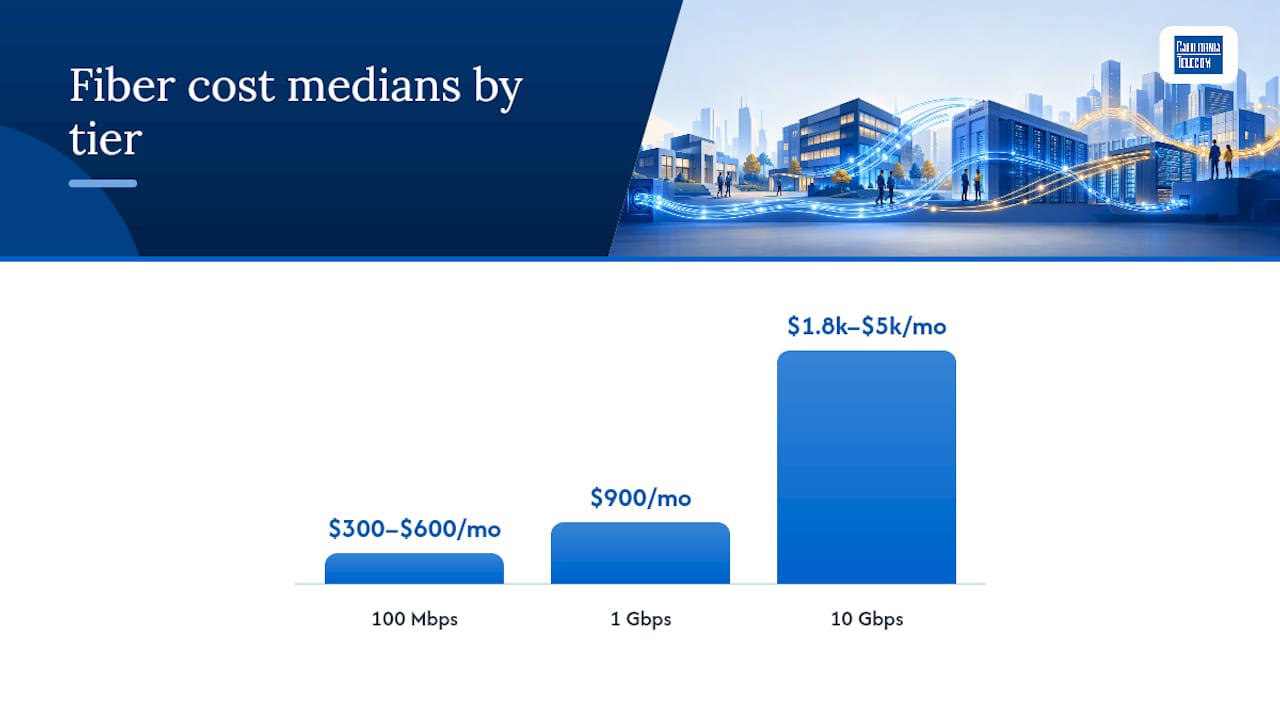
These figures come from Lightyear's DIA pricing guide and align closely with the tiered ranges Discover Communications reports across its carrier network, which lists 100 Mbps around $300 to $600 and 10 Gbps commonly landing between $1,800 and $5,000 or more.
Where you fall in that range depends heavily on geography and building type. On-net addresses inside metro fiber rings and colocation data centers routinely land near the 10th percentile because a carrier already has equipment in the building. Rural sites or buildings requiring new fiber construction push you toward the 90th percentile, sometimes past it once you factor in one-time build costs.
There's also a real difference between DIA and business broadband pricing, and it's worth understanding before you assume fiber is overpriced. Broadband medians run far lower, around $100/mo for 100 Mbps and $184/mo for 1 Gbps, but that's shared, contended bandwidth without a symmetrical guarantee or a real SLA. Comparing DIA vs broadband on price alone misses the point: you're not buying the same product.
Pro Tip: Bandwidth doesn't price linearly. The jump from 100 Mbps to 1 Gbps often costs only 2 to 3 times more, not 10 times more, so a growing site often gets better bandwidth-per-dollar economics by buying one tier higher than it thinks it needs.
What Drives the Price of Dedicated Fiber?
Two buildings a mile apart can get wildly different quotes for the same bandwidth, and it almost always traces back to a handful of variables.
- On-net vs. off-net status: if a carrier already has fiber in your building, you skip construction costs entirely; off-net sites absorb trenching, permitting, and make-ready charges.
- Distance to the carrier's point of presence (POP): longer backhaul runs mean more fiber to build and higher recurring cost to maintain it.
- Bandwidth tier: higher tiers cost more in absolute terms but usually less per Mbps.
- SLA level: a 99.999% guarantee with fast mean-time-to-repair costs more than a standard best-effort SLA.
- Type 1 vs. Type 2 access: Type 1 means the provider owns the last mile; Type 2 means they lease it from another carrier and pass along a markup.
- Contract term: longer terms typically buy lower monthly rates and waived installation.
- Redundancy and diverse pathing: a second physical route into the building adds monthly cost but eliminates a single point of failure.
- Colocation vs. standard office: data centers tend to have more carriers competing for your business, which pushes pricing down.
That Type 1 versus Type 2 gap isn't trivial. Lightyear's dataset shows Type 2 access carrying roughly an 18 to 20% average markup over Type 1 quotes at the 100 Mbps tier, purely because the provider is paying another carrier for last-mile access and passing that cost through. Ask every vendor which type they're quoting before you compare numbers side by side.
How Do Providers Price and Structure Fiber Contracts?
Every quote breaks into two buckets: the monthly recurring charge (MRC) and the non-recurring charge (NRC), and how you negotiate the second one often shapes the first.
- MRC is your ongoing monthly bill for the circuit itself, sometimes bundled with managed router or firewall service.
- NRC covers installation, and providers frequently amortize part of it into your MRC over a 1, 2, 3, or 5 year term rather than billing it upfront.
- Per-port vs. per-Mbps pricing: some carriers price the physical port regardless of usage; others price by committed bandwidth.
- Committed vs. burstable bandwidth: committed capacity is guaranteed and billed flat; burstable and 95th-percentile billing models charge based on actual usage above a baseline, which can save money for variable traffic but adds billing complexity.
- Managed vs. customer-premises equipment (CPE): a managed router folded into the MRC avoids a capital purchase but adds a recurring line item.
Pro Tip: Longer terms are your best negotiating lever. A 3 or 5 year commitment routinely gets NRCs waived entirely, and it's always worth explicitly asking whether Type 1 access is available at your address before signing a Type 2 quote.
How Much Does an SLA Level Change the Price?
An SLA is really a promise about downtime, and the difference between 99.9% and 99.999% uptime is bigger than the decimal points suggest. A 99.9% guarantee still permits about 8.76 hours of downtime a year. Move to 99.99% and that shrinks to roughly 52 minutes. At 99.999%, often called "five nines," you're down to around 5 minutes annually. Each jump in that ladder typically raises your monthly cost, because the provider has to build in more redundancy and faster response commitments to hit it.
SLAs also define mean-time-to-repair (MTTR), latency and jitter thresholds, and packet-loss limits, each with its own credit formula if the provider misses the mark. Certain support features consistently push price higher:
- 24/7 U.S.-based network operations center (NOC) monitoring
- On-site technician dispatch included in the SLA
- Priority escalation paths for outage tickets
- A dedicated account engineer instead of a shared support queue
If your business runs payment processing, patient records, or logistics dispatch, the SLA tier matters more than the headline bandwidth number.
How Long Does Fiber Installation Take and What Does It Cost Upfront?
Provisioning timelines vary enormously by how much new construction is involved. On-net installs where the carrier already has fiber in the building typically take 2 to 4 weeks. Near-net sites, close to existing infrastructure but requiring a short extension, often run 4 to 8 weeks. Off-net sites needing trenching or aerial construction can stretch 3 to 6 months or longer, especially if permits from a city or utility are required.

One-time costs follow the same pattern. A small metro on-net install might only carry a cross-connect fee and standard CPE installation, often a few hundred to a couple thousand dollars. A rural off-net project requiring trenching and make-ready work can run into the tens of thousands, occasionally more depending on distance and terrain.
Watch for these hidden fees before you sign:
- Cross-connect charges at the data center or meet-me room
- Fiber handoff or demarcation extension fees
- CPE installation and configuration labor
- Permit and right-of-way costs passed through from the provider
Pro Tip: Ask for the NRC broken out line by line, not as a lump sum. Vendors will often waive or reduce individual line items, like cross-connect fees, that they won't touch if the number is bundled.
How Should You Budget and Negotiate for Enterprise Fiber?
Comparing quotes apples to apples takes more discipline than most procurement teams give it, mostly because vendors structure proposals differently on purpose.
- Verify on-net status at your exact address, not just the neighborhood.
- Ask explicitly whether the quote is Type 1 or Type 2 access.
- Request an itemized NRC breakdown rather than a bundled installation fee.
- Confirm the SLA's uptime percentage, credit formula, and MTTR commitment in writing.
- Ask what hardware and support are included in the MRC versus billed separately.
- Model your bandwidth needs 2 to 3 years out, not just today's usage.
On the negotiation side, a few tactics consistently move the number. Bundling multiple sites under one contract gives you leverage a single-site request never will. Ask for the NRC to be waived outright rather than just discounted. Request a temporary bridge credit if your cutover date slips past your current contract's expiration. And always compare at least three carrier quotes using the identical bandwidth, term, and SLA inputs, otherwise you're comparing different products, not different prices.
Pro Tip: A procurement partner who works with 50+ carriers can often get better Type 1 pricing than you'll find calling vendors one by one, simply because they know which buildings are already lit and which carriers compete hardest at your address.
How Does a Managed Provider Change the Cost Equation?
Buying DIA directly from a single carrier means you own every relationship, every ticket, and every renewal negotiation. A managed provider changes that math by sourcing across dozens of carriers and taking on the engineering and monitoring work in-house.
Consider a retail or healthcare operator running 12 locations across three states. Negotiating with local carriers site by site means 12 separate contracts, 12 renewal dates, and 12 different points of failure if something breaks at 2 a.m. Consolidating that under one managed provider means one bill, one contract structure, and one team troubleshooting every site.
Multi-location businesses lose more to operational drag, chasing carriers, juggling vendors, reconciling separate invoices, than they typically lose to a slightly higher per-site rate. Consolidation is often the cheaper path once you count the hours spent managing it.
Californiatelecom sources from over 50 carriers nationwide, engineers and deploys each site with its own team, and backs every connection with a 24/7 U.S.-based NOC and a 99.99% uptime SLA on data services. That combination typically matters most for organizations with five or more locations, where the coordination overhead of managing multiple carrier relationships starts costing more than the savings from shopping each site independently.
Pro Tip: If you're running a single site, buying direct from a carrier is often the cheaper path. The managed model earns its premium once you're coordinating connectivity across multiple locations.
What Ongoing Costs Come After Installation?
The monthly circuit fee is rarely the only recurring cost tied to enterprise fiber. Managed router and firewall service, if not bundled into your MRC, typically adds its own line item. Static IP block allocations beyond the first few addresses often carry a small recurring fee. If your SLA includes proactive monitoring and alerting rather than reactive ticket response, that capability sometimes costs extra unless it's part of a managed package from the start.
Redundancy is the biggest hidden operational cost. A single fiber circuit, no matter how good the SLA, is still a single point of failure if a backhoe cuts the line. Many enterprises add a second physical path or a wireless backup circuit, which effectively doubles part of your connectivity spend but eliminates the catastrophic downtime scenario that a single circuit can't protect against.
Budget for periodic circuit audits too. As your organization adds locations or changes vendors, it's easy to keep paying for bandwidth or hardware you no longer need at a given site. A quarterly review of active circuits against actual usage catches that waste before it compounds across a multi-site footprint. None of this shows up on the initial quote, but it shapes your real total cost of ownership over the life of the contract.
What Does It Cost to Upgrade Bandwidth Later?
Scaling from 1 Gbps to 10 Gbps on an existing circuit is usually far cheaper than a fresh install, because the fiber is already run to your building. In most cases, an upgrade means a hardware swap at the router or switch and a change order on your existing contract, not new construction. Expect a modest one-time fee for the equipment change and a new MRC reflecting the higher tier, but skip most or all of the original NRC.
The exception is when your current circuit's physical capacity or the carrier's equipment at your building can't support the higher tier without new fiber. In that scenario, you're closer to a fresh off-net install cost profile than a simple upgrade, which is worth asking about before you assume scaling is cheap.
Contract timing matters here too. Upgrading mid-term sometimes triggers an early termination fee on the old tier's remaining commitment, while waiting until renewal lets you negotiate the new tier and term together. If you expect to double bandwidth within 18 months, it's often worth negotiating a step-up clause into the original contract rather than treating the upgrade as a separate future negotiation.
A Practical Recommendation for Multi-Location Buyers
If your sites are on-net and your SLA needs are moderate, SLA-backed broadband can work for secondary locations. But for anything mission-critical, or once you're managing more than a handful of sites, dedicated fiber through a managed provider beats piecing it together carrier by carrier.
Get an Enterprise Fiber Quote Built Around Your Locations
Every range in this article assumes a single site with a straightforward install. Real enterprise budgets get complicated fast once you're comparing quotes across five, ten, or fifty locations, each with different on-net status, different carriers competing locally, and different SLA needs by site type. Californiatelecom removes that complexity by sourcing from more than 50 carriers, engineering each install with its own team, and putting every location on one bill with one 24/7 U.S.-based NOC behind it.That structure means you're not stuck negotiating Type 1 versus Type 2 access at 12 different addresses yourself, or reconciling invoices from a dozen carriers every month. If you're planning a multi-site rollout or renewal cycle, start with Californiatelecom's nationwide managed network services page and request a quote that maps directly to the tiers and SLA levels covered above.
Frequently Asked Questions About Enterprise Fiber Cost
What is a normal enterprise fiber cost for a mid-size office? For a typical mid-size office needing 1 Gbps dedicated fiber, expect somewhere between $600 and $1,400 per month, depending on on-net status, SLA level, and contract term.
Is dedicated fiber always more expensive than broadband? Yes, on a straight monthly price comparison. Business broadband medians run closer to $100 to $184 monthly for comparable speeds, but broadband lacks the symmetrical bandwidth guarantee and enforceable SLA that dedicated fiber provides.
How much does it cost to install fiber if my building isn't on-net? Off-net installs vary widely, from a few thousand dollars for a short extension to tens of thousands for trenching or aerial construction over longer distances, plus permit costs where applicable.
Does a longer contract term always lower my monthly rate? Usually, yes. Providers frequently reduce MRCs or waive installation charges in exchange for a 3 or 5 year commitment instead of a 1 year term.
What's the difference between Type 1 and Type 2 access? Type 1 means the provider owns the physical last-mile connection to your building.
Sources
- 2026 Business Internet Cost Guide (with Real Data)
- Business Fiber Internet Quotes From 200+ Carriers — Free | Discover Communications
Recommended
- Why Dedicated Fiber Beats Broadband: Save Your Business from $9,000 Per Minute Downtime | California Telecom
- Business Fiber — Internet Services | California Telecom
- Enterprise WiFi vs Consumer WiFi: What Businesses Need to Know | California Telecom
- Benefits of Dedicated Fiber Internet for Business | California Telecom